Structural design: a box built around your product.
The structure decides whether a box protects, how it opens and what it costs to ship. We engineer the dieline, inserts and closure around your product — not the other way round.
- Custom dielines and inserts
- Right-sized to cut shipping cost
- Tested for fit before production
- Dielines
- Free
- Fit tolerance
- ±1/16 in
- Sample cutting
- CAD
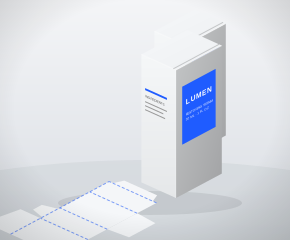
What structural design covers.
- Sizing. Internal dimensions measured from your product with the right clearance for the board and insert.
- Style selection. Choosing between mailer, tuck end, rigid and other styles based on product, channel and budget.
- Inserts. Card, corrugated, foam or molded pulp to stop movement and present the product.
- Closures. Tuck locks, crash-lock bottoms, tear strips, magnets and adhesive strips.
- Board specification. Thickness, flute and ECT strength for the weight and route.
Right-sizing pays for itself.
Carriers charge on dimensional (DIM) weight when a box is large for its weight. UPS and FedEx use a divisor of 139 for all packages; USPS uses 139 for parcels over 1,728 cubic inches (one cubic foot), rounding dimensions up to the next whole inch.
Example with UPS or FedEx: a 1.5 lb product in a 12 × 10 × 6 in box has a DIM weight of 720 ÷ 139 = 5.2, billed as 6 lb. Shrink the box to 10 × 8 × 4 in and the DIM weight drops to 320 ÷ 139 = 2.3, billed as 3 lb — half the billable weight, before you count the saved void fill.
Small changes in box size, multiplied across thousands of shipments, are often worth more than the cost of the box itself.
How we engineer a structure.
Measure
We take product dimensions (or you send a unit) and agree on clearances.
Design
Our structural designer builds the dieline in CAD packaging software.
Plain sample
A plotter-cut white sample confirms fit and opening.
Adjust
We refine tolerances, locks and inserts from your feedback.
Release
The final dieline is used for artwork and production.
Inserts: which material to choose.
| Insert | Best for | Notes |
|---|---|---|
| Paperboard | Light products, display | Recyclable; printable |
| Corrugated | Heavier items, shipping | Strong and recyclable |
| Foam | Fragile or luxury items | Premium hold; not curbside recyclable |
| Molded pulp | Electronics, bottles | Recyclable alternative to foam |
Frequently asked questions
What is a dieline?
A flat template showing the cut lines, fold lines and glue areas of a box. Artwork is laid out on it before printing.
Do you charge for custom dielines?
No. Dielines for our standard and custom structures are free with your order.
Can you match a competitor’s box structure?
We can build a similar structure for your product, sized and specified for your needs.
How much clearance should a box have?
Usually about 1/16 to 1/8 inch per side for snug retail cartons, more if there is an insert or the product needs cushioning.
Can I test the structure first?
Yes. A plain structural sample is the best way to confirm fit before printing.
Can you design packaging for an irregular product?
Yes. Send the product or a CAD file and we will design a custom insert.
Other services
Let’s engineer the right box.
Send product dimensions and weight. We’ll recommend a structure and send the dieline.