
Packaging resources for brands that want to get it right.
Straight answers to the questions we hear every day — sizes, dielines, artwork, materials and costs — so you can order with confidence.
- Written by packaging specialists
- Practical, not promotional
- Ask us anything not covered
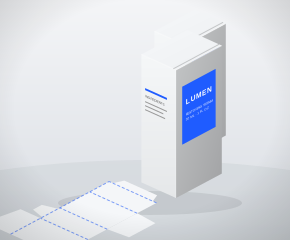
Five things to know before you order.
- Measure the inside. Box sizes are quoted as internal length × width × depth. Measure your product at its widest points and add clearance — see our structural design page for typical tolerances.
- Pick the structure for the channel. Shelf? Folding cartons and display boxes. Shipping direct? Mailers and shipping boxes. Gifting? Rigid boxes.
- Match the board to the weight. Paperboard for light retail products; corrugated for anything that ships on its own; rigid grayboard for luxury. See materials.
- Design in CMYK with bleed. RGB screen colors shift in print; artwork needs 1/8 in bleed. Our packaging design team checks files free.
- Size for shipping cost. Carriers bill dimensional weight; a smaller box can halve the billable weight.
In-depth guides.
Our full guide library is being published; the guides below go live progressively.
How to measure a box
Length × width × depth, measured the right way.
Dieline guide
What dielines are and how to set up artwork on one.
Box style guide
Every box style, compared by use and cost.
Paperboard vs corrugated
When to use each and why.
Artwork guidelines
Bleed, resolution, color and file setup.
Packaging glossary
ECT, CMYK, SBS, flute and 100 more terms.
Glossary: ten terms you’ll see on a quote.
| Term | Meaning |
|---|---|
| Dieline | Flat template of cut, fold and glue lines |
| SBS | Solid bleached sulfate — white paperboard |
| pt | Paperboard thickness in thousandths of an inch |
| Flute | The wavy middle layer of corrugated board (E, B, C…) |
| ECT | Edge crush test — stacking strength of corrugated |
| CMYK | Four-color process printing |
| PMS / Pantone | Pre-mixed spot color for exact matching |
| Bleed | Artwork extended past the cut line |
| Lamination | Film bonded to the printed sheet (matte, gloss, soft-touch) |
| MOQ | Minimum order quantity |
How to measure your product for a box.
- Stand the product the way it will sit in the box.
- Measure length (the longer side of the opening), width (the shorter side of the opening) and depth (height from opening to bottom), at the widest points including caps and closures.
- Add clearance: about 1/16–1/8 in per dimension for a snug carton; more for inserts or cushioning.
- Quote internal dimensions as L × W × D. External dimensions are larger by the board thickness — significant for corrugated and rigid boxes.
Artwork setup in brief.
- Work on the dieline we provide, at 100% scale.
- Use CMYK for full color and Pantone for exact brand colors.
- Extend background art 1/8 in past cut lines (bleed) and keep text 1/8 in inside folds and cuts.
- Images at 300 dpi at final size; fonts outlined; foil and spot UV on separate layers.
Our packaging design team checks every file free.
Frequently asked questions
What size box do I need?
Measure your product’s length, width and height at the widest points, then add clearance for the board and any insert. Our team can size it for you.
What is the difference between paperboard and corrugated?
Paperboard is a single solid layer for retail cartons; corrugated has a fluted middle layer and is used for shipping.
What file format should artwork be in?
Vector AI or PDF files, in CMYK, with 1/8 inch bleed and fonts outlined.
What does MOQ mean?
Minimum order quantity — the smallest number of boxes per order. Ours start at 50 units for many styles.
Are length, width and depth internal or external?
Box sizes are quoted as internal dimensions unless stated otherwise.
Question not answered here?
Ask a packaging specialist. You’ll get a straight answer, not a sales pitch.