Custom rigid boxes built to be kept.
Thick grayboard wrapped in printed or specialty paper, made partly by hand. Rigid boxes don’t flex, don’t fold flat and don’t get thrown away — which is exactly why luxury and gift brands use them.
- 1000–2000gsm grayboard
- Wrapped in printed or specialty paper
- Two-piece, magnetic, drawer and book styles
- Minimum
- 100 units
- Board
- 1.5–3 mm
- Production
- 12–15 days
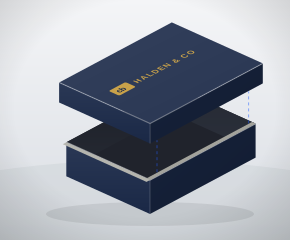
- Board
- 1500gsm grayboard
- Wrap
- 157gsm art paper
- Finish
- Matte lamination
- Logo
- Gold foil
How rigid boxes are made.
Rigid boxes are also called setup boxes, because they’re set up into their final shape at the factory rather than folded by you.
- Board cutting. Grayboard (chipboard) is cut and V-grooved so the corners fold sharply.
- Forming. The walls are folded up and the corners taped to make the box shell.
- Wrapping. A printed or specialty paper is glued and wrapped around the shell, turned over the edges and smoothed — by machine or by hand.
- Lining and inserts. The inside is lined and inserts are fitted.
- Finishing. Magnets, ribbons and closures are added; each box is inspected.
Because of the hand work and the board volume, rigid boxes cost more and take longer than folding cartons — typically 12–15 business days after proof approval.
Rigid box specifications.
| Styles | Two-piece, magnetic closure, drawer, book-style, shoulder neck, folding rigid |
|---|---|
| Board | 1000–2000gsm grayboard (about 1.5–3 mm) |
| Wraps | Printed art paper, textured and linen papers, black, holographic, kraft |
| Finishes | Matte/gloss/soft-touch lamination, foil, emboss/deboss, spot UV |
| Inserts | Foam, card, satin, molded pulp |
| Shipping | Ship assembled (collapsible styles ship flat) |
When rigid is worth it — and when it isn’t.
Worth it: gifts, jewelry, watches, fragrance, premium electronics, PR kits and anything where the box is part of the value. Customers keep rigid boxes for storage, which keeps your brand in their home.
Probably not: fast-moving consumer goods, products shipped in high volumes where freight cost dominates, or anything that’s discarded immediately. A well-designed folding carton or mailer with one premium finish often gets you 80% of the effect at a fraction of the cost.
Middle ground: collapsible rigid boxes ship flat and save significant freight and storage.
Rigid box costs explained.
| Cost factor | Why |
|---|---|
| Board volume | 1.5–3 mm grayboard uses far more fiber than a carton |
| Wrapping labor | Wrap paper is glued and turned by machine or hand |
| Inserts | Foam or card inserts are cut and fitted |
| Freight | Assembled boxes take up much more space |
Collapsible rigid boxes reduce freight and storage significantly.
Frequently asked questions
What is a rigid box?
A box made from thick grayboard wrapped in paper, set up into its final shape at the factory. Also called a setup box.
Why are rigid boxes more expensive?
They use much more board, involve partly manual wrapping and assembly, and ship assembled, which takes more freight space.
What is the minimum order for rigid boxes?
Rigid boxes start at 100 units.
Can rigid boxes ship flat?
Standard rigid boxes ship assembled. Collapsible (folding) rigid boxes ship flat and pop into shape.
Are rigid boxes recyclable?
The grayboard and paper are recyclable, but magnets, foam inserts and plastic laminations should be removed or avoided for easier recycling.
What is the difference between rigid and folding boxes?
Rigid boxes are thick and set up permanently; folding cartons are thinner and ship flat.
Compare other materials
Make it a box they keep.
Send your product, quantity and style. We’ll recommend board and wrap and send a 3D proof.